
How to Choose a HIPAA-Compliant IT Provider in South Florida
Practice managers: here is what to ask an MSP about BAAs, risk assessments, encryption and Florida FIPA breach rules before you sign. Verify, don't just trust.
Read
Facing a server refresh? Compare on premise server replacement options with private cloud migration on cost, performance, and South Florida storm risk.
If your server is getting old, you're probably asking the same question a lot of South Florida owners are asking right now: do we buy another box for the closet, or move this to the cloud? Both are reasonable answers. Neither is right for everyone. The honest answer depends on your applications, your compliance duties, and how much storm-season downtime you can stomach.
This post walks through the real costs, the risks, and a simple way to decide.
Server hardware typically runs on a 3-5 year replacement cycle. Typical industry benchmarks put servers at $5,000-$25,000 each, with Windows Server licenses at $1,000-$6,000 per server. Treat those as directional, not a quote.
The bigger driver is the calendar. According to Microsoft's lifecycle policy, extended support for Windows Server 2016 ends January 12, 2027 (Microsoft Windows Server Blog, February 2026). After that date, you stop getting regular security patches.
There is a safety valve. Extended Security Updates (ESU) are available for up to three years, through January 2030. But ESU requires Software Assurance or an equivalent subscription. It is also not offered through SPLA, the licensing model hosting providers use. So "just buy time" is not simple, and it may not work with every hosting arrangement.
That leaves three real on premise server replacement options:
The question isn't "cloud or server." It's which workloads belong where.
The sticker price of a new server is the smallest honest number in the room. A real budget includes:
Then come the hidden costs: downtime during cutover, backup and recovery add-ons, and the next refresh in 3-5 years.
On-prem still makes sense in some cases. Examples include latency-sensitive line-of-business apps, specialty equipment that has to sit next to the server, or data-residency requirements. If that's you, a refresh is a good choice, as long as it comes with a real recovery plan.
Our server and infrastructure support is a good starting point. A hardware health check shows what you have, how long it will last, and what to do next.
Cloud figures vary widely by environment. Treat everything below as an estimate.
Now the honest counterpoint. Steady-state cloud typically lands 5-30% above fully loaded on-prem cost. What you get for that is remote access, redundancy, and less maintenance.
Over the long term, the picture can flip. Some analyses find 20-40% lower total IT cost over five years for firms with 20-100 employees, and others estimate 20-30% average IT cost reductions after migration. That's directional only.
Possible offsets exist. AWS MAP credits can cover 25-40% of migration cost, though they only apply to AWS-bound projects.
The takeaway: ranges this wide mean your own workloads decide the number. Ask for a quote based on what you actually run.

Performance. A local server is fast for on-site apps. Cloud depends on your internet connection. If the line drops, cloud apps stop. That makes redundant internet part of any cloud plan.
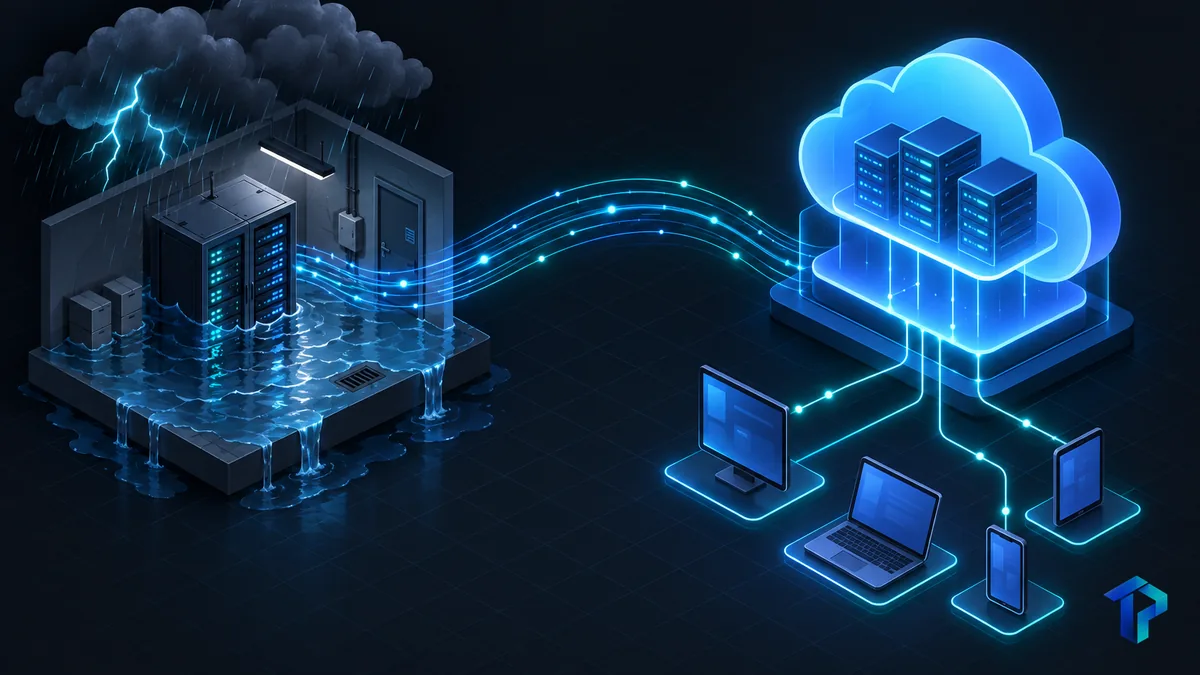
Storm risk. When comparing a physical server vs cloud storage business setup in South Florida, geography matters. Hurricanes, flooding, roof leaks, lightning, brownouts, and multi-day FPL outages can all hit a single-office server room. A generator and UPS help, but they don't help if the room floods.
Virtual server hosting benefits address that directly:
Cyber risk applies to both. Business email compromise and ransomware hit on-prem and cloud environments alike.
Cloud is not automatically secure. It's only as safe as its MFA, monitoring, and backups.
That's where cybersecurity and monitoring comes in, whichever model you choose.
Start with a checklist:
Then pick a path:
A typical migration follows five steps: assessment, pilot workload, parallel run, cutover, decommission. Pilot a non-critical system first and measure performance and admin effort. Negotiate exit terms before you sign, including data export and fees if you leave.
An MSP helps most with the parallel-run period, avoiding surprise costs, and managing the server either way.
It comes down to your apps, compliance duties, and how much storm downtime you can absorb. Hurricane, flood, and power risks push many local businesses toward cloud or hybrid. A workload assessment gives you a clear answer.
Hardware and licensing are only part of it. Installation, backup, and migration labor add to the total, and the right size depends on what you run. The most reliable way to get a number is a quote scoped to your environment.
Not automatically. Year one usually costs more because two environments overlap, and the long-term result depends on your workloads. What cloud reliably adds is redundancy and remote access.
Outages, flooding, roof leaks, and lightning surges can take a single-office server offline or destroy it. Off-site backups or a failover environment are what make recovery possible.
If backups live only on-site, they can be lost with the hardware. Tested off-site or cloud backups let you restore to new equipment. Verify restores before a disaster, not after.
It varies with workload count, data volume, and compliance needs, so we avoid quoting a fixed figure. Expect an assessment, a pilot, and a parallel run before cutover. A scoped plan sets the real schedule.
With the Windows Server 2016 deadline set for January 12, 2027, the time to plan is now, not the month before. TechPro IT Solutions can look at your current hardware, your workloads, and your storm exposure, then lay out your options in plain English. Start with a free IT assessment, or call (561) 922-8416.
Practice managers: here is what to ask an MSP about BAAs, risk assessments, encryption and Florida FIPA breach rules before you sign. Verify, don't just trust.
Hurricanes knock out wired internet fast. Here's how dual-WAN cellular failover keeps Boca Raton businesses running when storms hit.
Start with a free IT assessment — a clear, no-pressure look at where things stand and what managed IT could do for you.