
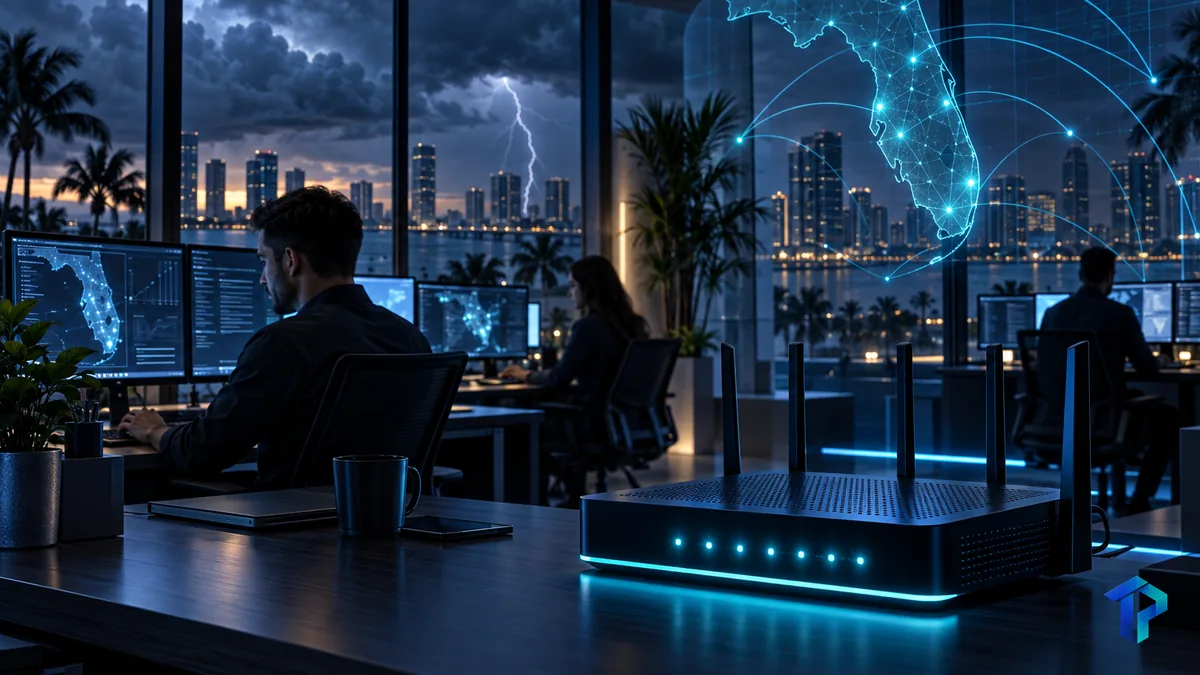
In-House Servers vs. Cloud Hosting: Deciding Your Business's Next Step
Server refresh time forces a choice: buy new hardware or move to the cloud. Here is how South Florida SMBs can compare cost, performance, and physical risk.
Read
Learn how dual-WAN cellular failover keeps Boca Raton businesses online during hurricanes. Get real outage data and a practical redundancy setup guide.
Boca Raton has weathered enough storm seasons that most business owners already know the drill: board up, top off the generator, and hope the power comes back fast. But there's a piece of the storm plan that gets overlooked constantly — internet connectivity. When your primary wired connection goes down, your point-of-sale system, your phones, your email, and your ability to process a single transaction go down with it. And in South Florida, wired lines tend to go down first.
When a hurricane moves through, the pattern is consistent: wired infrastructure goes down before cell networks do. That's not a coincidence — buried and aerial cable lines are exposed to downed trees, flooding, and pole damage in ways that distributed cell towers often aren't. Florida's storm history bears this out year after year.
Hurricane Irma showed the same pattern locally. In Hendry County, FCC filings recorded 78% of cell sites out of service two days after landfall — a rough number on its own, but every single one of the county's 18,750 electric accounts lost power entirely, the only county in Florida to hit 100% outage. Wired internet depends on that same power grid and the same exposed infrastructure. When the lines go down or the power goes out, a single wired connection simply can't route around the problem.
For businesses along the coast in Boca Raton and Delray Beach, salt air adds another layer of wear on outdoor cable and antenna equipment, which can shorten the life of infrastructure that's already stressed by storm season. A single point of failure just isn't a great bet in this climate.
If your only path to the internet is one wire, one storm is all it takes to go dark.
Losing internet for a few hours might sound like an inconvenience. For many small businesses, it's closer to an existential threat. According to FEMA, only 40-60% of small businesses reopen after being affected by a disaster. A Congressional Research Service analysis puts it even more starkly: about 40% of businesses never reopen after a disaster, and another 25% close within a year — especially when they don't have a continuity plan in place.
The financial hit adds up fast even outside worst-case scenarios. ITIC research found that many SMBs lose $25,000 or more per hour of downtime, with mid-market businesses in the 20-100 employee range averaging $8,000 to $25,000 per hour. A smaller operation — say a 10-to-15-person office or a boutique retail shop in the Tech Corridor near I-95 — usually isn't looking at figures that large, but the loss is still real: missed sales, staff sitting idle on the clock, and customers who don't come back after finding the doors effectively closed.
There's also a security angle that's easy to miss. Verizon's 2025 Data Breach Investigations Report found that SMBs experience ransomware in 88% of their breaches, compared to 39% for large enterprises. When your network goes unmonitored during an outage — no active firewall traffic review, no IT eyes on the environment — that's exactly the kind of gap attackers look for.
The fix isn't complicated in concept: don't rely on one connection. A dual-WAN setup pairs your primary wired internet (cable or fiber) with a secondary cellular LTE/5G connection through a dedicated router or modem. When the primary line drops, an SD-WAN appliance detects it and automatically reroutes traffic to the cellular link — no one has to unplug anything, restart a router, or call in a favor.
This matters because the switch happens in seconds, not minutes, and it happens without staff needing to do anything. In a normal, localized outage — a cut line, a damaged pole a few blocks over — registers keep ringing, phones keep ringing, email keeps flowing, and nobody at the front counter needs to know a failover even occurred. During a major regional disaster, it's a bit more complicated: cellular towers can face extreme congestion as thousands of residents pile onto mobile networks at once. Failover keeps the connection alive, but traffic shaping and bandwidth prioritization become critical to make sure the systems that matter most — payments, phones — stay functional while less important traffic gets pushed aside.
The reliability of that cellular backup has actually improved industry-wide. In 2022, the FCC adopted mandatory resiliency rules for wireless networks during emergencies, building on a 2016 voluntary framework that had already been in place for years. The results show up in the data: during Hurricane Idalia, only 1.2% of cell towers went dark, while nearly 59,000 wired subscribers lost service. That's a meaningful gap in favor of cellular as a backup path — and part of why pairing wired and cellular is now a standard piece of any solid network redundancy solutions plan.
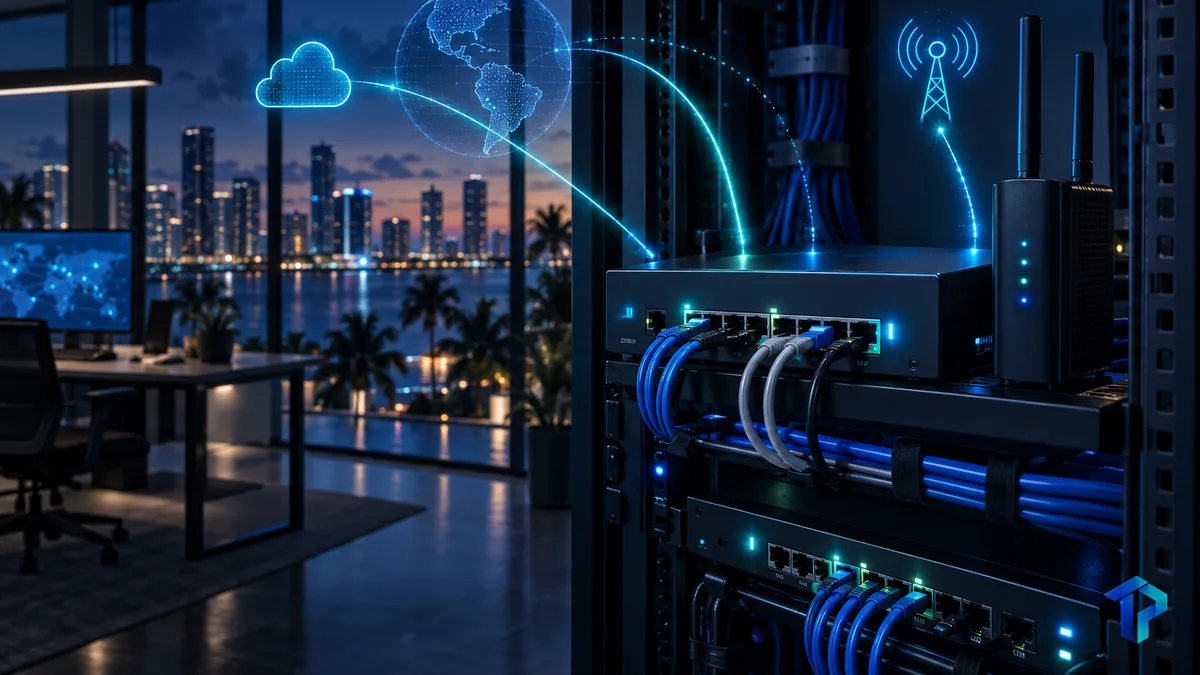
Picture a retail store on Federal Highway during hurricane season. The primary cable connection goes down when a line is damaged a few blocks away. With a dual-WAN setup in place, the store's point-of-sale system automatically shifts to the cellular backup — customers can still check out. A well-configured setup also applies traffic prioritization (QoS) at that moment, automatically deprioritizing or disabling non-essential traffic like guest Wi-Fi so it doesn't saturate the limited cellular bandwidth and choke the payment terminal.
A professional office — a law firm or accounting practice, say — faces a different but related risk: phones and email are the lifeline. The same failover setup keeps VoIP calls and inbox access running on cellular while the wired line is repaired.
Worth noting for buildings in Boca Raton specifically: a lot of commercial construction here is thick concrete block (CBS) with hurricane-rated impact glass, and both can badly degrade cellular signal indoors. A cellular failover router that works fine on a bench test can struggle to get a usable signal once it's installed inside a building like that. An external antenna or an active signal booster is often necessary to make the cellular backup actually usable indoors, not just present.
The economics here favor caution. An LTE/5G modem and data plan is a modest, predictable operating cost. Compare that to the downtime figures above, and the backup connection pays for itself the first time it's actually needed. Pairing that cellular router with a UPS battery backup is worth the extra step too — during a power outage, the router and modem need to stay powered long enough for failover to actually kick in.
A few practical habits make the difference between a redundant setup that works and one that just sits there:
Redundant internet is one piece of a larger continuity picture. It works best paired with cloud backups and monitored cybersecurity, so that data and security posture hold up even when the network topology shifts under storm stress. The cloud failover strategies that make sense for hurricane season generally assume a redundant connection is already in place underneath them.
It's also worth keeping some perspective: outside of major storms, Florida's average outage duration actually beats the national average — 1.1 hours versus 2.2 hours nationally, per EIA data. That baseline reliability is exactly why a dual-WAN setup pays off — most of the year it's quietly doing nothing, and then during the two or three weeks a season when a storm threatens, it's the reason your doors stay open.
The best time to have this conversation with your Boca Raton IT support team is before a storm is named and spinning in the Atlantic, not after. A professional network assessment before hurricane season can flag single points of failure — an aging modem, one ISP, no UPS — while there's still time to fix them.
The risk here is lopsided: a redundant connection is a modest, ongoing cost, and the alternative is losing thousands of dollars an hour and possibly not reopening at all. For small business managed IT clients across Palm Beach and Broward counties, that math tends to make the decision easy once it's laid out clearly.
TechPro IT Solutions works with businesses across South Florida every hurricane season to design failover setups that actually hold up when the wind picks up. If your current setup is one wire and a prayer, let's fix that before the next system forms — schedule a free assessment and we'll walk your network end to end.
The most reliable method is dual-WAN failover: pairing your primary wired connection with a cellular LTE/5G backup router. When your cable or fiber line goes down, SD-WAN technology automatically shifts traffic to the cellular link so operations continue without interruption.
Typically it involves a business-grade router or SD-WAN appliance connected to both your existing ISP and a cellular modem, with automatic failover configured. TechPro can design and install this so failover happens in seconds, not minutes.
LTE/5G routers from carriers with diverse cell tower coverage work best, since FCC data shows cell sites recover faster than wired lines after storms. Choosing a provider different from your primary ISP's backbone adds an extra layer of redundancy.
Costs vary by data usage and hardware, but most SMBs pay a modest monthly fee compared to the $8,000-$25,000+ per hour that downtime can cost, according to ITIC research. It's a low-cost insurance policy against major revenue loss.
It varies widely — during Irma, some counties had cell sites down more than a week, while power outages after Ian averaged 9.2 days in hard-hit areas. Outside major storms, Florida actually outperforms the national average with just 1.1 hours of downtime.
Yes, as long as you have a cellular backup device already installed and configured before the storm hits. Waiting until an outage occurs to set this up often means delays in equipment and activation.
Retail businesses should prioritize keeping POS systems online, which a dual-WAN cellular failover setup handles automatically while deprioritizing non-essential traffic like guest Wi-Fi. Pairing this with a UPS battery backup ensures registers and routers stay powered even during brief electrical outages.
Server refresh time forces a choice: buy new hardware or move to the cloud. Here is how South Florida SMBs can compare cost, performance, and physical risk.
Practice managers: here is what to ask an MSP about BAAs, risk assessments, encryption and Florida FIPA breach rules before you sign. Verify, don't just trust.
Start with a free IT assessment — a clear, no-pressure look at where things stand and what managed IT could do for you.