

5 Signs Your South Florida Business Has Outgrown Break-Fix IT Support
Surprise repair invoices and repeat outages signal that break-fix has stopped working. Here are five signs it's time to move to proactive device management.
Read
MFA, EDR, backups, and training: the security controls insurers now demand from South Florida SMBs before they'll issue or renew cyber coverage.
Cyber insurance applications used to be a formality — check a few boxes, get a quote, move on. That's not how it works anymore. Insurers have paid out enough claims that they now know exactly which gaps lead to losses, and they underwrite accordingly. Without these controls, you risk outright denial or facing significantly higher premiums with restrictive exclusions. Here's what carriers actually require now, and how South Florida businesses can get ahead of it.
The numbers explain the shift. Over the last two years, data from the National Association of Insurance Commissioners shows US cyber insurance claims climbing to nearly 50,000 in 2024 — up roughly 40% year-over-year — and that pace hasn't slowed since. Small and mid-size businesses account for a large share of those claims, and in our experience the payouts add up fast enough that carriers can no longer treat them as background noise in their loss ratios.
Florida makes this personal. The FBI's IC3 2024 Annual Report found that Florida was among the top three states nationally for internet crime complaints, alongside California and Texas — a pattern that has held true year after year. Insurers underwriting policies for South Florida businesses know this territory is expensive to cover.
Their response has been straightforward: tighten underwriting. No controls, no policy — or a policy priced high enough, and hedged with enough exclusions, that it barely helps when something happens.
Most carriers have converged on the same baseline stack, whether you're a five-person real estate office in Boca Raton or a fifty-person logistics company near the Port of Miami:
Each requirement traces back to how businesses actually get breached. According to Verizon's 2025 Data Breach Investigations Report, one of the more established baselines in the industry, stolen credentials are involved in 88% of basic web application attacks — which is exactly why MFA has moved from "nice to have" to "required to bind coverage." Ransomware, meanwhile, is tied to 75% of system-intrusion breaches in the same report, which is why EDR and real backup discipline show up on nearly every application.
The other shift: underwriters are done taking your word for it. A growing number of applications now ask for proof — screenshots of MFA enforcement, vendor attestations for EDR deployment, logs of your last restore test — instead of a self-reported yes/no. Documenting your current controls in writing, before the renewal questionnaire lands, saves a lot of scrambling later.
For a while, "we have MFA" was enough of an answer. Not anymore. CISA calls phishing-resistant MFA the gold standard and urges every organization to adopt it as part of a broader Zero Trust approach. That's a meaningfully higher bar than a text-message code.
Only two categories of MFA actually meet CISA's phishing-resistant definition: PIV/PKI smartcards, and FIDO2/WebAuthn-based methods — security keys, passkeys, and built-in device authenticators like a laptop's fingerprint reader. NIST and CISA have warned for years that SMS codes are highly vulnerable to interception, steering businesses toward hardware-based or app-based cryptographic authenticators instead.
"Do you have MFA?" is turning into "which kind, and where?"
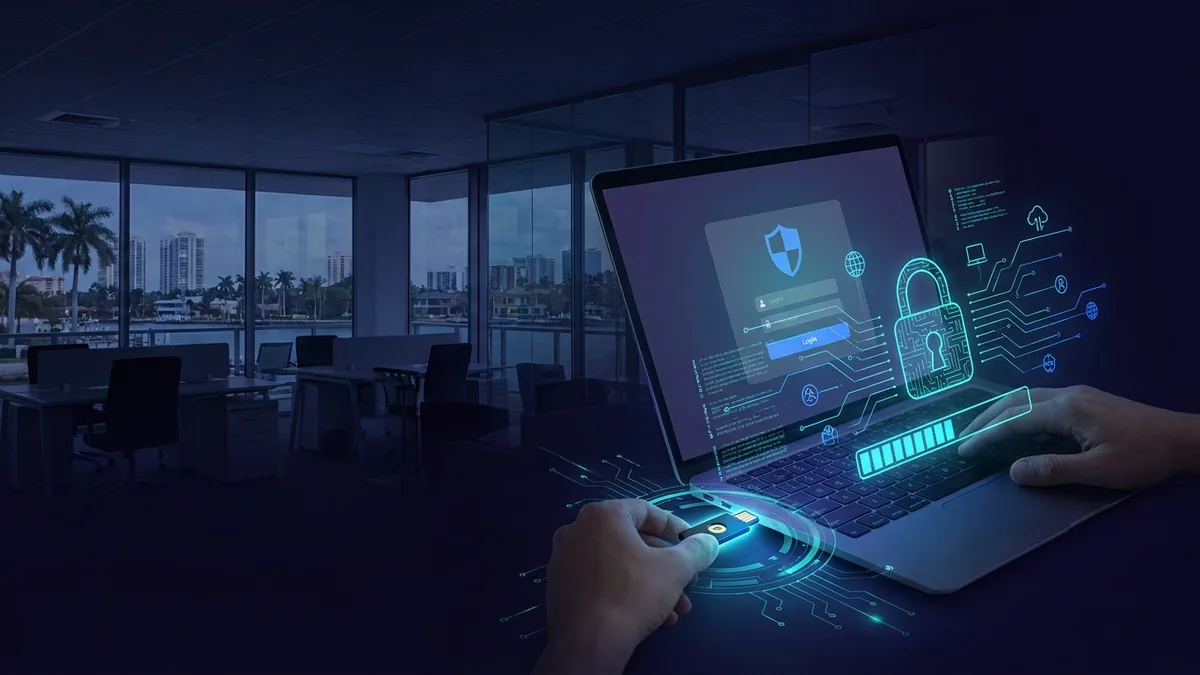
CISA's guidance is specific about placement, too: MFA belongs on email, file storage, remote access, and every single admin account, no exceptions. That's the same list insurers are now working from. If you're weighing options for implementing MFA and IAM across your organization, this is the moment to prioritize phishing-resistant methods over whatever's fastest to roll out.
Backups sound like a solved problem until you look at what attackers actually do. In our experience, and consistent with broader industry research on ransomware incidents, attackers routinely go after backups specifically — not as a side effect, but as a deliberate step to remove the recovery option before demanding payment.
That's why insurers no longer accept "we have a backup" as a real answer. They want to know if it's immutable, offline, or air-gapped — meaning an attacker who's already inside your network can't reach it or encrypt it too. A backup sitting on the same server, or the same login credentials, doesn't count for much.
Restore testing is the other piece that's moved from optional to expected. A backup nobody has ever tried to restore from is a theory, not a plan. Insurers are increasingly asking for evidence of a completed test, not just a backup schedule on paper.
The stakes explain the scrutiny: recent industry reporting, in IBM's 2025 Cost of a Data Breach Report, puts the global average breach cost at about $4.4 million. Insurers verify recoverability up front because a business that can restore quickly costs them far less than one that can't. For businesses here, this pairs naturally with hurricane season planning — the same tested, offsite backup and disaster recovery setup that satisfies an insurer also protects you before the next storm knocks out power or connectivity for days.
Falling short doesn't just mean a slightly higher bill. Carriers can non-renew a policy outright, raise premiums sharply, or add exclusions that carve ransomware or business email compromise (BEC) claims out of coverage entirely — right when you'd need them most.
BEC is a particular focus right now. It accounted for $2.77 billion in reported losses in 2024 alone, according to the FBI's IC3 Annual Report, and that figure has become a baseline reference point for insurers assessing risk. That's a big part of why insurers scrutinize email security and MFA so closely at renewal time — BEC losses hit insurers directly.
Some carriers now require a signed attestation confirming your controls are actually in place. That's not a formality — misrepresenting your security posture on these documents can lead to denied claims or policy cancellation during a post-incident audit. And renewal questionnaires keep getting longer and more technical every cycle. Waiting until renewal season to discover a gap is a losing strategy; by then, you're negotiating from a weak position instead of a documented one.
The practical starting point is a gap assessment measured against your actual insurer's application — not a generic checklist. From there:
Local businesses — from Delray Beach hospitality operations with heavy seasonal turnover to Boca Raton title and real estate offices handling escrow accounts — often find it easier to meet these requirements with a managed partner who can produce the documentation and attestations insurers ask for, rather than assembling it from scratch during renewal week. That's the gap our cybersecurity & monitoring services are built to close, and it's a core part of how we provide IT support for small businesses across the region.
Cyber insurance requirements aren't going to get simpler — they're only going to ask for more proof, more often. The businesses that stay ahead of it treat these controls as part of running the company, not a scramble before a renewal deadline. If you operate a South Florida business and aren't sure where your current setup stands against what your insurer will actually ask for, schedule a free IT assessment and we'll walk through the gaps together.
Most carriers now require multi-factor authentication, endpoint detection and response (EDR), tested offline or immutable backups, and documented employee security training. Many applications also ask about email filtering, patch management, and incident response plans.
Yes — MFA is now a near-universal requirement, especially on email, remote access, file storage, and admin accounts. Increasingly, insurers want phishing-resistant MFA (FIDO2/WebAuthn or PKI-based), since CISA and NIST no longer treat SMS codes as sufficient for high-assurance use.
Insurers generally want backups that are offline, immutable, or air-gapped, since attackers routinely target accessible backups as part of a ransomware attack. Many also require proof of regular restore testing, not just that backups exist.
EDR is increasingly a stated requirement, particularly for businesses handling sensitive data or remote endpoints. Insurers see EDR as a core control because catching an intrusion early, before it spreads across the network, is typically what separates a contained incident from a full-blown breach.
You may face a steep premium increase, added exclusions for ransomware or BEC claims, or outright non-renewal. In some cases, misrepresenting your security controls on a renewal questionnaire can also lead to a denied claim or policy cancellation after an incident.
It's becoming very difficult. Most carriers now treat MFA and tested backups as baseline requirements, and applications without them are often declined outright or priced much higher with restrictive exclusions.
Surprise repair invoices and repeat outages signal that break-fix has stopped working. Here are five signs it's time to move to proactive device management.
Server refresh time forces a choice: buy new hardware or move to the cloud. Here is how South Florida SMBs can compare cost, performance, and physical risk.
Start with a free IT assessment — a clear, no-pressure look at where things stand and what managed IT could do for you.