
5 Signs Your South Florida Business Has Outgrown Break-Fix IT Support
Surprise repair invoices and repeat outages signal that break-fix has stopped working. Here are five signs it's time to move to proactive device management.
Read
Passwords alone can't stop modern phishing. Learn how IAM cyber security and MFA protect SMBs, cut breach costs, and satisfy cyber insurance requirements.
A few years ago, a strong password felt like enough. Lock the front door, change the password every 90 days, move on with your day. That era is over. Across South Florida offices — from law firms in downtown Boca Raton to medical practices in Boynton Beach — the businesses getting hit hardest aren't the ones with weak firewalls. They're the ones where a single stolen password was the only thing standing between an attacker and the entire network. This is where identity and access management, or IAM, comes in — and why it's quickly becoming as basic a requirement as antivirus software once was.
Here's the uncomfortable truth: stolen or compromised credentials were the single most common way attackers broke into businesses in 2024, and breaches that started this way took nearly 10 months on average to even identify and contain, according to IBM's Cost of a Data Breach Report 2024. That's not a typo — almost a year of an attacker potentially sitting inside your systems before anyone notices.
It gets worse. Verizon's 2024 Data Breach Investigations Report found that nearly 38% of analyzed breaches used compromised credentials — more than double the number that relied on phishing and exploitation combined. And this isn't a new trend. Over the past decade, stolen credentials have shown up in roughly 31% of all breaches tracked by Verizon.
A firewall can't stop an attacker who simply logs in with a password an employee reused somewhere else.
That's the real problem. Employees reuse passwords across personal and work accounts. They share logins with coworkers to save time. They pick something memorable instead of something secure. No amount of network hardware fixes that — because the front door was never locked in the first place.
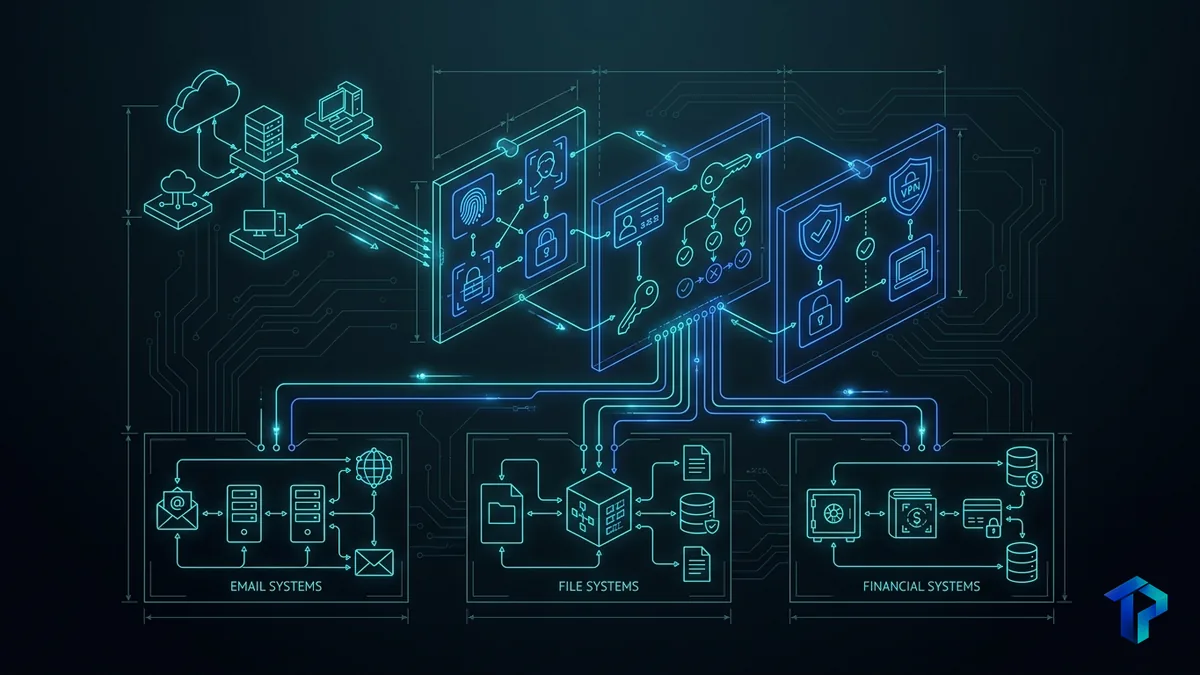
Identity and access management, or IAM, is really just a formal name for a simple question: who gets access to what, and under what conditions? Instead of trusting a password alone, IAM systems verify who someone is, what they're allowed to touch, and whether the circumstances of their login look normal.
In practice, IAM cyber security for a modern office is built from a handful of core pieces: multi-factor authentication (MFA), single sign-on (so employees aren't juggling a dozen passwords), role-based access (so a front-desk employee doesn't have the same access as your controller), and conditional access policies (which can flag or block a login attempt from an unusual location or device).
MFA is the centerpiece. According to CISA, multi-factor authentication can block up to 99% of automated, bulk cyberattacks — the kind of mass credential-stuffing and password-spraying attempts that hit businesses of every size, every day. It's not a guarantee against a determined, targeted attacker, but it closes the door on the overwhelming majority of attempts that would otherwise walk right in. That's why CISA consistently urges every organization — regardless of size — to require MFA for all users and all services, especially email, file sharing, and financial account access.
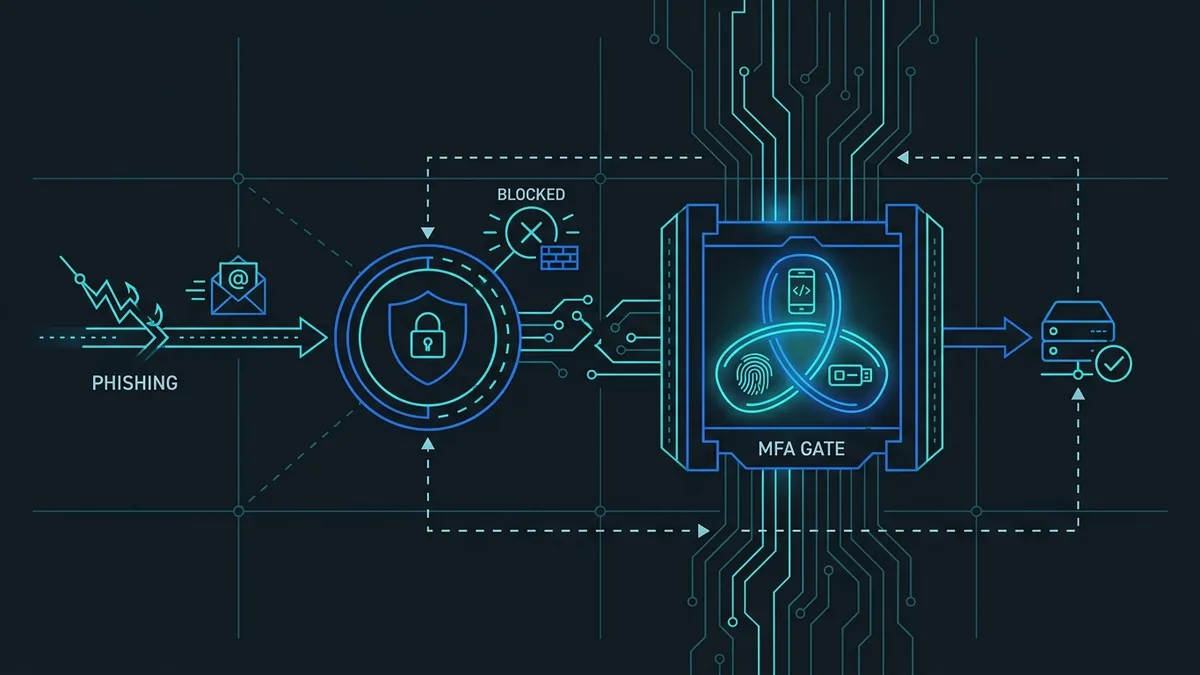
For businesses ready to go further, CISA points to FIDO/WebAuthn as the current gold standard in phishing-resistant authentication. Unlike a text-message code, FIDO is built so that even if an employee is tricked into visiting a fake login page, the protocol itself blocks the attempt. It's the closest thing available today to a login that can't be phished.
The financial case for IAM isn't theoretical. The global average cost of a data breach hit $4.88 million in 2024 — a 10% jump, and the biggest single-year increase since the pandemic, per IBM's Cost of a Data Breach Report. Meanwhile, companies that already had IAM in place saw their average breach costs run roughly $223,000 lower than businesses without it, according to the same report. That's a reduction in the damage when something goes wrong — not a stack of cash arriving each year. Think of it less like a savings account and more like a smaller repair bill after an accident, because you already had the safety features installed.
Automation adds another layer of savings: organizations using security AI and automation extensively saved an average of $1.9 million per breach, according to IBM's 2025 Cost of a Data Breach Report. IAM systems are often the backbone that makes that kind of automated detection possible in the first place.
For small and mid-size businesses specifically, one threat deserves special attention: Business Email Compromise. BEC losses hit $2.77 billion in 2024, according to the FBI's Internet Crime Complaint Center (IC3) — and it's a threat that IAM controls, particularly MFA on email accounts, directly mitigate. The FBI's IC3 logged 859,532 total cybercrime complaints in 2024, with an average loss of $19,372 across all complaints reported. For a small office, that's not a rounding error — it's payroll.
If your business carries cyber insurance — or is shopping for it — you've probably already noticed the underwriting questions have gotten sharper. Most Florida carriers now treat MFA as a baseline condition of coverage, not an optional upgrade. Skip it, and you may find yourself either uninsurable or facing a denied claim after the fact.
The data backs up why insurers are so strict about this. In Verizon's 2025 DBIR, 88% of Basic Web Application attacks — one of the top attack patterns tracked — involved stolen credentials. Overall, 22% of breaches began with credential abuse and 16% began with phishing. And it's not just your own systems insurers care about: third-party and vendor involvement in breaches doubled year-over-year, now accounting for 30% of all breaches, up from 15% the year prior. That means your insurer is also scrutinizing how contractors, vendors, and partners access your systems — not just your own employees.
If you're preparing for a renewal or a new policy, our cyber insurance checklist walks through the full list of controls carriers typically expect to see documented.
The good news: rolling out IAM doesn't mean flipping a switch and disrupting your whole office overnight. A phased approach works better and causes far less friction.
A few habits make the rollout smoother in practice: start your team on a password manager so nobody's reusing logins across accounts, use hardware security keys for admin accounts rather than relying on authenticator apps alone, and test your account-recovery process before an employee actually gets locked out during a busy week. It's also worth auditing which third-party apps have access to your core systems through your identity provider — that list tends to grow quietly over time.
For offices managing a distributed or seasonal team — common across hospitality and tourism-driven businesses in Palm Beach and Broward counties — unified identity management matters even more, since staff are logging in from more devices and more locations than a typical single-office setup.
Not every business needs the same IAM setup. A five-person accounting office in Delray Beach doesn't need the same complexity as a 200-employee financial services firm in downtown Boca Raton — and trying to force enterprise-grade tooling onto a small team usually just creates confusion and support tickets instead of security. The goal is a system sized to your business, not the biggest one available.
This is where a local partner earns its keep. A provider offering small business IT support can bundle IAM implementation with ongoing monitoring, help desk support, and compliance guidance — instead of leaving you to configure and maintain it alone. For businesses across the region, South Florida managed IT support means someone local understands both the technology and the practical realities of running an office here, hurricane season included.
At TechPro IT Solutions, IAM and MFA rollout are part of our cybersecurity services — built specifically for the size and structure of small and mid-size businesses, not bolted on from an enterprise playbook.
Passwords alone were never designed to stop the kind of attacks businesses face today. IAM — MFA, single sign-on, role-based access — closes the gap that stolen credentials keep walking through. If your office hasn't reviewed its identity and access setup recently, now's the time. Schedule a free IT assessment and we'll show you exactly where the gaps are.
Most managed IT providers, including us, bundle IAM into a per-user monthly fee alongside help desk and monitoring services, so you're not buying and managing a separate system on your own. The exact cost depends on how many users you have and what's already in place — a firm with 10 employees and basic Microsoft 365 licensing looks very different from a 50-person office with multiple business applications. A free assessment is the fastest way to get real numbers for your office.
Pretty much, yes. Most carriers now treat MFA on email, remote access, and privileged accounts as a baseline requirement, not a nice-to-have. Show up to renewal without it and you may pay more, get denied coverage outright, or find a claim contested later. Our cyber insurance checklist walks through what underwriters typically ask for.
Once an attacker has one working password, they often have the keys to email, financial systems, and client files — because that password unlocks more than employees realize. Recovery isn't just a tech fix either; it means notifying clients, dealing with your bank or insurer, and sometimes weeks of disruption. It's the kind of mess that's far cheaper to prevent than to clean up.
Start small: lock down email and financial accounts first, then expand from there. Single sign-on actually reduces login hassle for employees rather than adding to it, and a managed IT partner can handle the configuration and staff questions in the background so your team barely notices the transition.
Correct — passwords get reused, shared, and guessed, and stolen credentials are consistently one of the top ways attackers get into small business networks. Adding MFA closes off the vast majority of automated attack attempts that specifically target weak or reused logins. It's a small daily habit change for a much stronger front door.
It helps a lot, even when someone clicks the wrong link. If an employee accidentally enters credentials on a fake site, MFA still requires a second step the attacker doesn't have, which stops most takeover attempts cold. Phishing-resistant options like security keys go a step further by refusing to work on a fake site at all.
Surprise repair invoices and repeat outages signal that break-fix has stopped working. Here are five signs it's time to move to proactive device management.
Server refresh time forces a choice: buy new hardware or move to the cloud. Here is how South Florida SMBs can compare cost, performance, and physical risk.
Start with a free IT assessment — a clear, no-pressure look at where things stand and what managed IT could do for you.