
5 Signs Your South Florida Business Has Outgrown Break-Fix IT Support
Surprise repair invoices and repeat outages signal that break-fix has stopped working. Here are five signs it's time to move to proactive device management.
Read
Choosing HIPAA compliant IT support in South Florida? Use this buyer's guide to vet BAAs, risk assessments, encryption and Florida FIPA readiness in an MSP.
If you run a medical practice in South Florida, you probably searched for "it managed services near me" at some point. You found a dozen names, and every one of them said "HIPAA-ready." Here's the problem: that phrase means nothing until someone shows you proof. This guide walks you through how to check a provider before they touch your patient data.
Compliance is a shared responsibility. Aligning with these standards dramatically reduces regulatory and cyber risk, but no IT service can guarantee absolute immunity from security incidents or regulatory audits.
If your IT provider can reach electronic protected health information (ePHI), it is a business associate under HIPAA. That includes remote help desk access, backups, email administration and server management. Its security practices become part of your risk.
Regulators are moving in this direction. The proposed Security Rule (90 FR 898, published January 6, 2025) would require your risk analysis to cover risks from subcontractors, service providers and cloud environments. Your provider's own security would be part of your analysis.
The stakes are real. Civil penalty figures that took effect January 28, 2026 (91 FR 3672) put Tier 4 violations at up to $2,190,294 each, with an annual cap of $2,190,294. Criminal penalties reach up to $250,000 and ten years in prison for intent to sell, transfer or use information for commercial advantage, personal gain or malicious harm.
A nearby provider with a friendly website is not the same as a provider whose compliance you have verified.
The 2025 proposal is not final. OCR continues to enforce the existing Security Rule. According to the federal Unified Agenda, publication of the final Security Rule update is projected for July 2027.
Here is what the proposal would change:
So what do you do while the rule is in limbo? Choose a provider already operating to the stricter standard. Retrofitting later costs more, and a breach doesn't wait for the final rule. For a deeper look, read our post on the end of addressable security.
A Business Associate Agreement is the first document to request. Ask to see the template and review it with your attorney before signing. A solid BAA covers:
Then dig further:
A provider that refuses a BAA, or says it is "not a covered vendor," is a red flag. Walk away.
Ask how they run a HIPAA risk assessment for a medical practice. Request their method and a sample deliverable, with client details removed. A real assessment lists assets, threats, findings and a tracked remediation plan.
Then check the controls. Ask for evidence, such as policies, screenshots and reports:
Also ask how often they run vulnerability scans and penetration tests, whether an independent third party performed them, and how findings are tracked to closure. Our cybersecurity and monitoring service is built around this kind of documented, ongoing work.
If a provider can only describe their security out loud, assume you're hearing marketing.
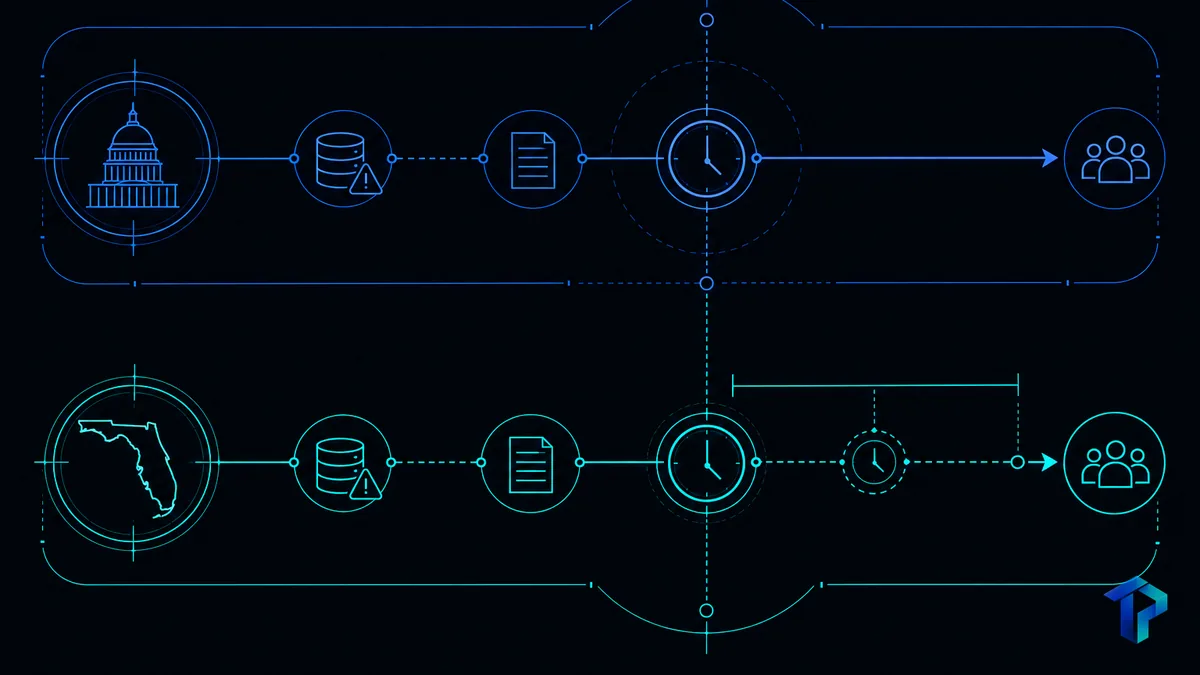
HIPAA isn't the only clock. Under the Florida Information Protection Act (Fla. Stat. § 501.171):
FIPA violations are enforced under FDUTPA. Civil penalties for late notification run up to $1,000 per day for the first 30 days and $50,000 per subsequent 30-day period, capped at $500,000.
Ask the provider how its incident response plan meets both HIPAA and FIPA timelines, and who drafts the notices. Have your attorney confirm how the two laws interact. This is general information, not legal advice.
Watch for these:
Build a simple scorecard: BAA, risk assessment, technical safeguards, incident response, and local on-site support in South Florida. Ask for references from other healthcare practices and actually call them. Also ask how the provider's practices line up with your cyber insurance requirements.
Ask for a signed BAA, their latest risk assessment methodology, written security policies and evidence of controls such as encryption, MFA and logging. No government body certifies HIPAA compliance, so documentation and proof matter more than badges.
It should cover permitted uses of ePHI, required safeguards, breach reporting timelines, subcontractor obligations, and return or destruction of data at termination. Confirm the MSP's subcontractors are bound by equivalent agreements.
As a practice manager, your next step is to put both laws into one incident response plan. Ask your provider to show you a single timeline that covers the federal and Florida notification duties, and name who drafts and sends the notices.
Not in every case today, but waiting buys you nothing. Ask your provider to confirm in writing where encryption and MFA are already active on your email, devices, backups and remote access, and to put any gaps on a dated fix list.
Current rules require an ongoing, documented risk analysis. The proposed rule would require one at least annually, which is a sensible cadence to adopt now, plus a review after major system changes.
Choosing an IT provider is a compliance decision as much as a technical one. If you want a second set of eyes on your current setup, see our medical office IT support and request a free IT assessment. You can also call us at (561) 922-8416.
Surprise repair invoices and repeat outages signal that break-fix has stopped working. Here are five signs it's time to move to proactive device management.
Server refresh time forces a choice: buy new hardware or move to the cloud. Here is how South Florida SMBs can compare cost, performance, and physical risk.
Start with a free IT assessment — a clear, no-pressure look at where things stand and what managed IT could do for you.