
In-House Servers vs. Cloud Hosting: Deciding Your Business's Next Step
Server refresh time forces a choice: buy new hardware or move to the cloud. Here is how South Florida SMBs can compare cost, performance, and physical risk.
Read
Slow apps, siloed branches, and rising costs signal it's time for a new network architecture. See how SD-WAN unifies multi-location businesses.
Most multi-site networks were built for a different era — one where email and file shares were the heaviest thing traveling across the wire. Site-to-site VPNs and router-centric designs handled that fine. They were never designed for cloud applications, video conferencing, and point-of-sale systems all running at once, at every branch, every day.
As businesses add locations, IT teams typically respond by patching in another point solution — a new firewall here, a backup circuit there — instead of stepping back and designing a unified architecture. It's understandable; nobody plans a network overhaul during a busy expansion. But the patchwork catches up eventually.
The market has already noticed. 87-90% of businesses have deployed or are actively deploying SD-WAN, according to the TeleGeography WAN Manager Survey [F2], and Lumen data put the number of enterprises using it or committed to adopting it within two years at 95% [F3] — a transition that, from where we sit in 2026, has largely already played out. That's not a fringe upgrade anymore — it's the default way multi-location businesses connect their sites.
The first sign is usually the one your staff complains about before IT even notices: cloud apps lag at the Delray office but run fine in West Palm Beach. VoIP calls drop at one branch. The POS system freezes during a lunch rush at one store but never at another.
Part of this comes down to bandwidth availability itself — some pockets of Palm Beach and Broward counties still have fewer high-speed provider options than others, which can leave one branch with meaningfully better circuits than another even within the same company.
But availability isn't the same as good performance. Even where fast connections exist at every site, a static, router-based network can't intelligently decide which traffic gets priority or which path to take. Bottlenecks often trace back to one root design flaw: all branch traffic gets backhauled through a single central hub instead of routed directly, based on real-time conditions.
Fast internet at every location doesn't matter if the network routing it can't tell a video call from a bulk file transfer.
A simple way to check where you stand: monitor actual bandwidth usage across sites during peak hours. If you're regularly hitting 70-80% of capacity, that's usually when day-to-day work starts to suffer — and it's a sign your network and monitoring, not just your bandwidth, need a second look through proper network and Wi-Fi management.
The second sign shows up in your IT team's workload, not your users' complaints. Each branch has its own firewall, its own configuration, sometimes its own ISP — put in place by whoever set up that location at the time. Troubleshooting becomes guesswork because no two sites are configured the same way, and enforcing a consistent security policy across all of them is nearly impossible.
The bigger issue is visibility. Without a single dashboard, IT can't see what's happening across all locations at once — they're logging into one router at a time, one firewall at a time, trying to piece together what's actually going on. Manually connecting multiple office networks this way works for two or three sites. It falls apart past that.
If your business has grown from two or three South Florida locations toward five or more — a common path for regional franchises and expanding practices — this siloed structure is exactly the problem that centralized, software-defined WAN architecture was designed to solve. Instead of managing each site as its own island, one platform manages routing, policy, and security for every branch together.
Ask your IT staff, or yourself, how much time gets spent troubleshooting connectivity issues rather than doing strategic work. If the answer is "most of it," that's a structural problem, not a staffing one.
The third sign is the one that doesn't show up until something goes wrong — and by then it's expensive. If any of your locations accept card payments, network segmentation matters. PCI DSS doesn't strictly mandate segmentation, but it's strongly recommended, since it lets you focus security resources where they matter most [F11].
Under PCI DSS Requirement 11.3/4, businesses that rely on segmentation to reduce compliance scope must regularly test that segmentation to confirm it actually isolates the cardholder data environment from the rest of the network [F12] — with guidance recommending penetration tests be performed at least annually [F13]. The PCI Security Standards Council has also published new guidance specifically addressing scoping and segmentation in multi-cloud and micro-segmented environments [F14], reflecting how much more complex this has become as businesses spread infrastructure across sites and cloud platforms.
A flat or loosely segmented multi-site network can't contain this kind of exposure. If one branch's point-of-sale network isn't properly separated from guest Wi-Fi or back-office systems, a breach at one location can expose the whole business — not just that site. This is exactly where cybersecurity and monitoring needs to be part of the network conversation, not an afterthought bolted on later.
Financial services firms and franchises with locations spanning Boca Raton to Fort Lauderdale face this acutely: inconsistent segmentation across branches is often the single biggest compliance gap auditors find.
The fourth sign is the one that lands on the P&L. Network-related downtime is particularly costly for small and midsize distributed businesses, averaging $1,203 per incident [F15] — and that figure is a conservative average weighted toward smaller operations. For a growing multi-site retail or medical group, hourly losses during peak tourist or shopping seasons in South Florida are often considerably higher than that average suggests. Multiply that across a handful of sites experiencing occasional outages, and it adds up fast — often quietly, buried in lost productivity rather than a single visible line item.
Cost also creeps in through redundant infrastructure: extra circuits, overpriced dedicated links, and duplicate IT tools purchased separately at each site instead of managed as one system. Businesses trying to reduce internet costs across multiple locations frequently discover the real driver isn't the ISP bill — it's an outdated architecture that requires more redundant hardware and more manual management than a modern design would.
Seasonal swings make this worse. Hospitality and retail businesses from Boynton Beach into Broward County often see significant traffic spikes during tourist season, and hurricane season brings its own bandwidth surges as locations lean on network connectivity for emergency communication. A network that's already stretched thin during normal months has little room to absorb either.
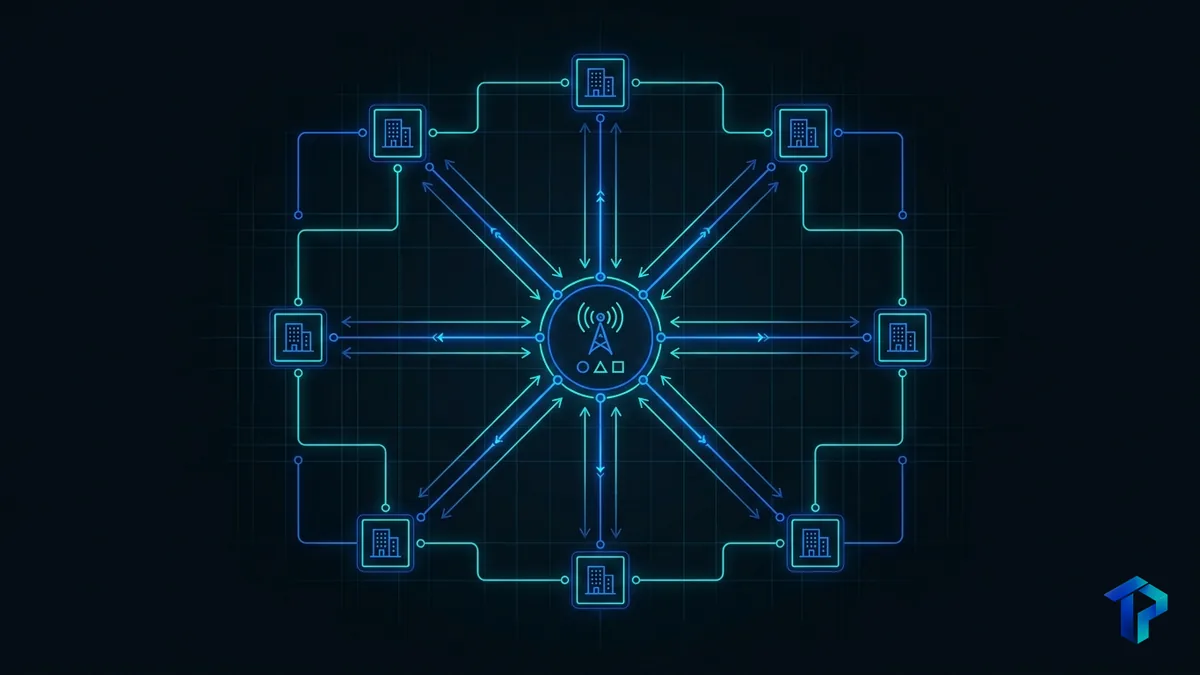
The common thread across all four signs is the same: a network built site-by-site instead of designed as one system. SD-WAN addresses that directly. It unites every branch connection into a single, centrally managed overlay that dynamically routes traffic based on real-time conditions — sending voice and video down the fastest path while less time-sensitive traffic takes another route, automatically.
Adoption reflects how mainstream this has become. As of 2026, the majority of mid-market businesses have already transitioned to software-defined networks, with small and mid-sized businesses catching up quickly thanks to the cost-efficiency and simpler branch management it offers [F5].
For a multi-site business, the practical benefit is one dashboard: one place to see performance across every location, apply a consistent security policy, and manage segmentation without logging into five different firewalls. That's the architecture we design for growing, multi-location clients — you can read more about building a secure SD-WAN network and how it applies to businesses expanding across Palm Beach and Broward counties.
If any of these four signs sound familiar — sluggish performance at some sites, IT managing each location separately, unresolved segmentation gaps, or downtime that keeps nudging up your costs — your network has likely outgrown the design it was built on. That's a common, fixable stage of growth, not a failure on your team's part.
TechPro IT Solutions works with multi-site business IT support across Boca Raton, Delray Beach, Boynton Beach, and West Palm Beach to redesign networks around how the business actually operates today. If you're seeing any of these signs, schedule a free IT assessment and we'll walk through what a centralized, SD-WAN-based architecture would look like for your locations.

Slowness usually comes from outdated architecture that backhauls all traffic through one central location instead of routing it intelligently. Add inconsistent bandwidth, aging routers, and no visibility into per-site performance, and delays compound as you add locations.
Start by auditing bandwidth, latency, and configuration consistency at each site. Most businesses see the biggest gains by moving to SD-WAN, which dynamically routes traffic and centralizes management instead of relying on static, site-by-site setups.
SD-WAN (software-defined wide area network) unifies branch connections into one centrally managed, intelligently routed network. If you operate more than two locations and struggle with inconsistent performance, security policy, or rising connectivity costs, it's likely worth evaluating.
Common signs include inconsistent app performance between locations, IT teams managing each site separately, unresolved security or PCI segmentation gaps, and rising downtime costs. Any one of these signals your architecture hasn't kept pace with growth.
SD-WAN lets you use lower-cost broadband circuits at each site instead of expensive dedicated MPLS lines, while still maintaining performance and reliability through intelligent traffic routing. Consolidating management also reduces the IT overhead tied to maintaining disparate systems.
Bottlenecks typically stem from routing all branch traffic through a single hub, inconsistent bandwidth between locations, and a lack of centralized traffic prioritization. Cloud application growth and video traffic have made these older designs increasingly inadequate.
Server refresh time forces a choice: buy new hardware or move to the cloud. Here is how South Florida SMBs can compare cost, performance, and physical risk.
Practice managers: here is what to ask an MSP about BAAs, risk assessments, encryption and Florida FIPA breach rules before you sign. Verify, don't just trust.
Start with a free IT assessment — a clear, no-pressure look at where things stand and what managed IT could do for you.