
5 Signs Your South Florida Business Has Outgrown Break-Fix IT Support
Surprise repair invoices and repeat outages signal that break-fix has stopped working. Here are five signs it's time to move to proactive device management.
Read
Legacy VPNs are slowing down your clinics, warehouses, and offices. Learn how SD-WAN and next-gen firewalls secure multi-site business networks in South Florida.
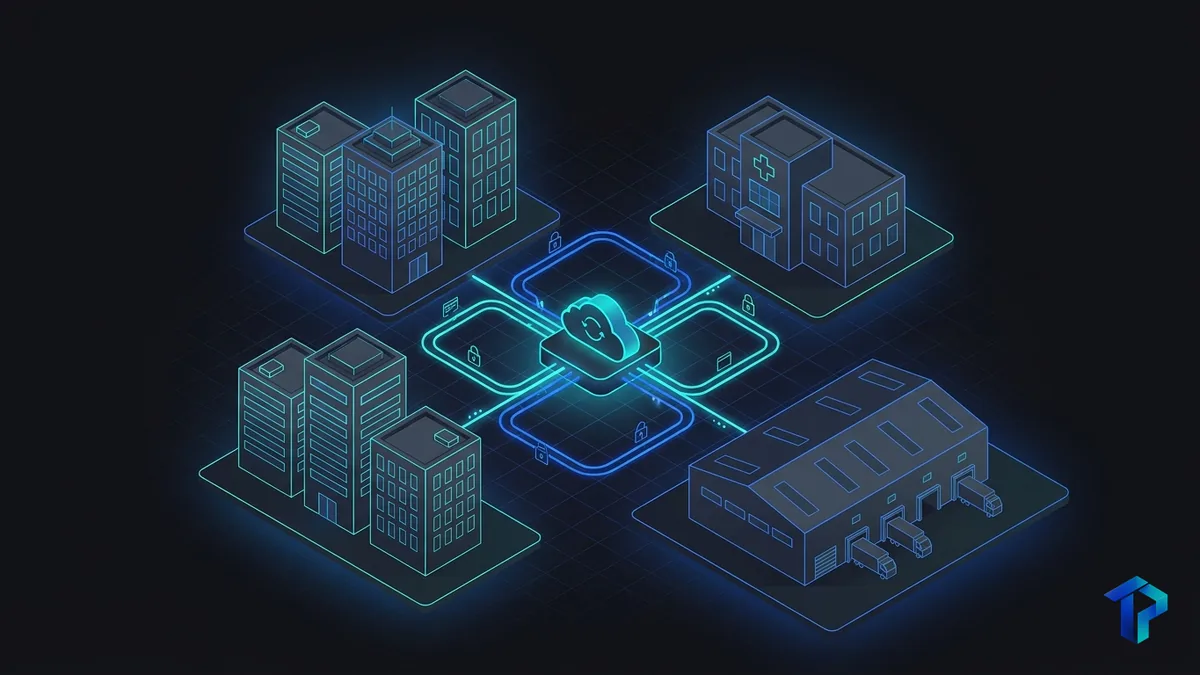
If your business runs out of two or three locations — an office in Boca Raton, a warehouse near Port Everglades, a clinic in West Palm Beach — you've probably built your network the same way most growing companies do: a VPN tunnel back to headquarters, added connection by connection as you expanded. It worked fine when you had one location and a slow, quiet internet. It doesn't hold up anymore, and the cracks show up first in downtime and second in your cyber insurance renewal.
Site-to-site VPNs were designed for a much simpler internet — fewer threats, lighter traffic, and applications that mostly lived on a server down the hall. That model routes everything through one central tunnel, usually back to a data center at headquarters. Every email, every file, every point-of-sale transaction from every branch takes the same road home before it goes anywhere else.
That works until it doesn't. Backhauling all traffic through one location creates latency for everyone outside that building, and it turns your headquarters connection into a single point of failure. If that link goes down — from an ISP outage, a hardware failure, or a hurricane knocking out power in West Palm Beach — every other site goes down with it.
And increasingly, the thing that takes a business offline isn't a router dying of old age. According to ITIC's 2024 Hourly Cost of Downtime Report, 84% of firms now cite security incidents as their top cause of downtime, ahead of human error. That's the real case for rethinking multi-site business network security from the ground up, starting with how sites connect to each other.
More locations mean more doors. Every branch office, clinic, or warehouse with its own internet connection, its own Wi-Fi, and its own set of logins is another entry point for an attacker to try.
The scale of the problem is national, but Florida sits squarely in it. The FBI's IC3 2024 Internet Crime Report logged 859,532 complaints and more than $16 billion in reported losses, and Florida was among the top-3 states for complaint volume, behind only California and Texas. The average loss per complaint was $19,372.
Small and mid-size businesses aren't catching a break here. In our experience, SMBs face outsized ransomware risk compared to large enterprises, in part because they often have fewer layers of network defense standing between an intruder and the rest of the business. A modest incident can still be expensive enough — in downtime, recovery costs, and lost business — to put real strain on a company that wasn't prepared for it.
Every unsecured branch, clinic, or warehouse location is one more door an attacker can try — and in a multi-site business, you only need one door left unlocked.
A traditional VPN builds static tunnels between sites. Failover is manual, routing rules rarely change, and — as covered above — all traffic funnels through one hub whether it needs to or not.
SD-WAN (software-defined wide area network) works differently. It dynamically selects the best path for each type of traffic in real time, based on what's actually happening on the network right now. A video call gets routed differently than a bulk file transfer. Centralized cloud management means your IT team — or your managed provider — can see and adjust policy across every site from one dashboard, instead of logging into each router individually.
The practical upside for a small or mid-size business: SD-WAN supports direct-to-cloud traffic. Microsoft 365, point-of-sale systems, and electronic health record platforms can connect straight to the cloud service they need, without detouring through headquarters first. That cuts latency and removes the single-point-of-failure problem entirely.
SD-WAN also typically runs across multiple connection types at once — broadband, LTE, fiber — with built-in redundancy. If one link drops during an ISP outage or a tropical storm rolling through South Florida, traffic shifts to the next available path automatically. That's a meaningfully different resilience story than a single VPN tunnel that either works or doesn't. Getting this right usually means pairing SD-WAN with solid network and Wi-Fi management at every site, not just the flagship office.
Connectivity is only half the picture. The other half is what happens once traffic arrives — and that's where firewalls and network security firewalls in general earn their keep.
CISA's guidance on communications infrastructure recommends strong network segmentation using router access control lists, stateful packet inspection, firewall capabilities, and DMZ (demilitarized zone) constructs. VLANs and private VLANs add a more granular layer on top, letting you isolate point-of-sale systems, IP cameras, guest Wi-Fi, and clinical devices from your core business network. If a guest laptop or a compromised camera gets infected, it shouldn't have a path to your financial records or patient data. We've written before about IP camera network segmentation specifically, because cameras and access control panels are now full network devices, and they need to be treated that way.
CISA also recommends placing externally facing services — DNS, web servers, mail servers — in a DMZ, separated from the internal LAN and backend systems. That way, if one of those public-facing services gets probed or exploited, the attacker still hits a wall before reaching anything sensitive.
Joint guidance from NSA and CISA extends this same thinking to the cloud: cloud segmentation policies should mirror what you enforce on-premises, using the same default-deny approach and the same access verification standards, rather than treating cloud environments as a looser, separate world.
For a multi-site business, the practical takeaway is that next-gen firewalls belong at every location, not just headquarters. A branch office with no firewall of its own is a soft target even if HQ is locked down tight. Combine that with segmenting sensitive departments — finance, HR — so they're only reachable by role and location, and you've built real defense-in-depth instead of one strong front door and unlocked windows everywhere else.

There's no single number here — cost depends on how many sites you're connecting, how much bandwidth each one needs, and what tier of firewall hardware makes sense for a clinic versus a warehouse versus a financial services office in Boca Raton. A five-site logistics operation near the Port of Miami has different needs than a three-office wealth management firm.
What's changed is how this gets billed. Managed SD-WAN typically bundles hardware, monitoring, and support into one predictable monthly cost, rather than a large upfront capital purchase followed by whoever's available fixing it when something breaks. That predictability matters when you're budgeting against the alternative: even a modest security incident can bring costly downtime, recovery expenses, and lost business that dwarf a predictable monthly cost. Weighed against that kind of exposure, proactive network investment shifts risk management from an unpredictable emergency capital expense to a predictable operating cost.
It's also increasingly a requirement, not a preference. Cyber insurance carriers are asking applicants to document segmentation and firewall standards before they'll write or renew a policy, and vague answers don't satisfy an underwriter the way they used to.
A few things separate a good multi-site network partner from one that only looks good on paper:
TechPro IT Solutions builds multi-site rollouts around this checklist, combining SD-WAN, site-level firewalls, and ongoing cybersecurity and monitoring services so every location — from a Delray Beach storefront to a Broward distribution center — gets the same standard of protection as headquarters, not a scaled-down version of it.
The most effective approach combines SD-WAN for intelligent traffic routing with next-gen firewalls at every site, not just headquarters. This creates encrypted, segmented connections between locations while allowing direct, secure access to cloud apps like Microsoft 365. A managed provider can design and monitor this architecture across all your Florida locations.
VPNs create static point-to-point tunnels that route all traffic through a central hub, causing latency and single points of failure. SD-WAN dynamically selects the best path for each type of traffic and includes centralized management and built-in redundancy. For businesses with 3+ locations, SD-WAN generally outperforms legacy VPN on speed, resilience, and manageability.
Clinics should deploy next-gen firewalls with VLAN segmentation to separate clinical devices, EHR systems, and guest Wi-Fi, following CISA's segmentation guidance. A DMZ should isolate any externally facing services from internal patient data systems. This layered approach supports HIPAA compliance while reducing ransomware exposure, which is a persistent risk for clinics handling patient data.
Inventory and POS systems should sit on their own segmented VLAN at each warehouse, isolated from general office traffic and IoT devices. SD-WAN can securely link this segmented traffic back to a central inventory database without exposing it to the broader internet. Firewall policies should enforce default-deny rules matching what's used in your cloud environment.
Costs depend on the number of sites, bandwidth requirements, and firewall hardware, but managed SD-WAN is typically billed as a predictable monthly service rather than large upfront capital spend. Weigh this against breach exposure: the downtime, recovery costs, and reputational damage from even a modest security incident often exceed what a predictable monthly network investment would have cost. A free IT assessment can provide a specific quote based on your locations.
Yes, TechPro IT Solutions designs, deploys, and monitors SD-WAN and firewall infrastructure for multi-site businesses across Miami-Dade, Broward, and Palm Beach counties. This includes 24/7 monitoring, local hands-on support, and vendor-agnostic hardware selection. Visit our multi-site business IT support page to learn more.
If your offices, clinics, or warehouses are still connected the way they were five years ago, it's worth a second look before hurricane season or your next insurance renewal forces the issue. Our multi-site business IT support team can map out what a modern, segmented network looks like for your specific locations — schedule a free IT assessment and we'll walk through it with you.
Surprise repair invoices and repeat outages signal that break-fix has stopped working. Here are five signs it's time to move to proactive device management.
Server refresh time forces a choice: buy new hardware or move to the cloud. Here is how South Florida SMBs can compare cost, performance, and physical risk.
Start with a free IT assessment — a clear, no-pressure look at where things stand and what managed IT could do for you.